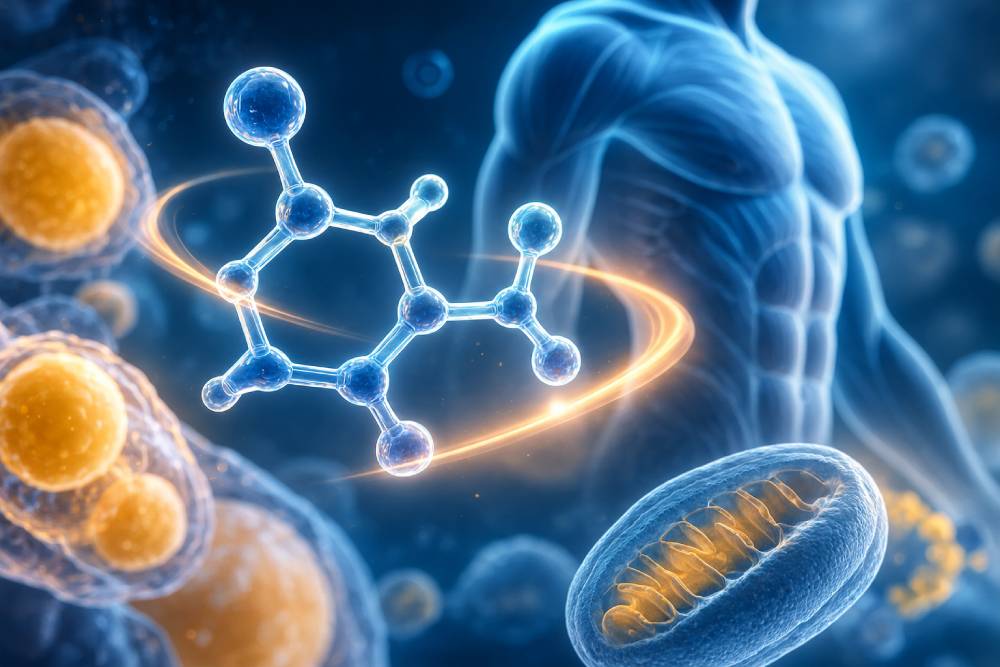
Could targeting a single metabolic enzyme open new possibilities for understanding how the body regulates energy, fat storage, and muscle function?
Metabolic health is about much more than calories consumed and calories burned. Behind the scenes, an intricate network of enzymes helps determine how cells process nutrients, regulate energy, and respond to changes in their environment.
One increasingly interesting area of research centers on 5-Amino-1MQ, an investigational compound that inhibits an enzyme called nicotinamide N-methyltransferase, or NNMT.
Researchers are studying NNMT inhibition for its potential relevance to fat metabolism, cellular NAD+ availability, metabolic flexibility, and age-related muscle function.
While the research remains preclinical, several findings offer intriguing possibilities for future metabolic health research.
5 Potential Benefits of 5-Amino-1MQ Being Explored in Research
The most exciting findings surrounding 5-Amino-1MQ come from laboratory and animal studies investigating the relationship between NNMT activity and metabolic regulation.
1. Fat Metabolism and Body Composition
One of the most studied areas of NNMT inhibition is its relationship to adipose tissue and energy storage.
NNMT activity has been associated with metabolic changes observed in obesity. Researchers have investigated whether inhibiting this enzyme can alter how fat cells manage energy.
A study published in Biochemical Pharmacology examined selective NNMT inhibitors in mice with diet-induced obesity and reported improvements in obesity-related outcomes.
The findings raise an interesting possibility: metabolic regulation may be influenced not only by how much energy enters the body, but also by the biochemical pathways that determine how that energy is processed.
Why this matters: Understanding NNMT activity could contribute to future strategies for studying adipose tissue biology and metabolic efficiency.
Read the research in Biochemical Pharmacology
2. NAD+ Metabolism and Cellular Energy
Nicotinamide adenine dinucleotide, better known as NAD+, is essential to cellular metabolism.
It participates in hundreds of biochemical reactions, including processes involved in energy production, cellular signaling, and DNA repair.
NNMT uses nicotinamide, a form of vitamin B3 that can otherwise participate in the NAD+ salvage pathway.
This creates an intriguing research question:
What happens when scientists influence the pathways that consume NAD+ precursors rather than simply supplying additional precursors?
NNMT inhibition is being investigated as one way to better understand this relationship.
Unlike NAD+ precursor supplementation strategies involving compounds such as nicotinamide riboside (NR) or nicotinamide mononucleotide (NMN), NNMT inhibition targets an enzyme involved in nicotinamide metabolism.
The distinction is scientifically important, although it has not been established that 5-Amino-1MQ increases NAD+ levels or improves cellular energy in humans.
Why this matters: Research into NNMT may help scientists better understand the balance between NAD+ synthesis, utilization, and metabolic regulation.
3. Muscle Strength and Healthy Aging
Perhaps one of the most compelling developments in NNMT research comes from a 2024 study published in Scientific Reports.
Researchers investigated NNMT inhibition, using 5-Amino-1MQ, alongside exercise in aged mice.
The results were noteworthy:
- Mice receiving NNMT inhibition without exercise demonstrated approximately 40% greater grip strength than sedentary controls.
- Mice participating in the exercise intervention without NNMT inhibition demonstrated approximately 20% greater grip strength than sedentary controls.
- Mice receiving both NNMT inhibition and exercise demonstrated approximately 60% greater grip strength than sedentary controls.
These results were observed in aged mice under controlled experimental conditions, not in humans.
The researchers also identified changes in muscle-related metabolic pathways, suggesting that NNMT inhibition and exercise may influence some distinct biological processes.
Why this matters: Preserving muscle function is an important area of healthy-aging research. These findings introduce NNMT as a potential target for future investigations into muscle physiology, adaptation, and age-associated functional changes.
Read the 2024 Scientific Reports study
4. Metabolic Adaptation During Caloric Restriction
Weight management involves complex biological adaptations.
When caloric intake changes, the body responds through adjustments in energy expenditure, nutrient utilization, hormonal signaling, and tissue metabolism.
A 2021 study published in Scientific Reports explored NNMT inhibition alongside a reduced-calorie diet in mice with diet-induced obesity.
The researchers observed changes in body composition and metabolic outcomes, supporting further investigation into how NNMT activity interacts with nutritional interventions.
This is particularly interesting because metabolic adaptation remains a major area of research in weight management.
Why this matters: Understanding the biochemical processes associated with dietary changes could eventually help researchers develop more comprehensive approaches to metabolic health.
Importantly, these findings do not establish that 5-Amino-1MQ enhances dieting results in humans.
Read the 2021 Scientific Reports study
5. SIRT1 Signaling and Metabolic Flexibility
Another interesting aspect of NNMT research involves its relationship with SIRT1, a protein involved in cellular responses to nutrient availability and metabolic stress.
SIRT1 belongs to a family of NAD+-dependent enzymes called sirtuins.
These enzymes participate in cellular processes associated with energy regulation, stress responses, and metabolic adaptation.
Because NNMT influences nicotinamide metabolism, scientists are investigating how changes in NNMT activity may affect NAD+-dependent signaling pathways.
This creates a potential connection between NNMT inhibition, SIRT1 activity, and broader metabolic regulation.
Why this matters: Understanding these interactions could provide new insight into how cells adapt to changing energy demands.
The relationship is biologically interesting, but the ability of 5-Amino-1MQ to improve SIRT1 signaling or metabolic flexibility in humans has not been established.
What Exactly Is 5-Amino-1MQ?
5-Amino-1MQ, also known as 5-amino-1-methylquinolinium, is a small-molecule compound developed for research into NNMT inhibition.
Although it is sometimes discussed alongside peptides in metabolic health circles, 5-Amino-1MQ is not a peptide.
Its primary research interest comes from its ability to inhibit NNMT, an enzyme involved in nicotinamide methylation.
Understanding NNMT: A Small Enzyme With an Important Metabolic Role
NNMT catalyzes the transfer of a methyl group from S-adenosylmethionine (SAM) to nicotinamide, producing 1-methylnicotinamide.
This reaction connects two important biochemical systems:
NAD+ metabolism: Nicotinamide can be recycled through the NAD+ salvage pathway, making its availability relevant to cellular metabolism.
Methylation metabolism: SAM serves as a methyl donor for numerous biochemical reactions involved in normal cellular function.
By participating in both pathways, NNMT occupies an interesting position at the intersection of energy metabolism and methylation biology.
A landmark 2014 study published in Nature demonstrated that reducing NNMT expression influenced metabolic outcomes in mice with diet-induced obesity.
That study helped establish NNMT as a promising area for metabolic research.
Read the landmark Nature study
5-Amino-1MQ and GLP-1 Research: An Interesting Scientific Question
With growing interest in GLP-1 receptor agonists, researchers and clinicians are increasingly focused on the broader biology of weight management, including body composition, muscle preservation, and metabolic adaptation.
This creates an opportunity to investigate metabolic pathways beyond appetite regulation.
GLP-1 medications and NNMT inhibitors operate through different biological mechanisms.
GLP-1 receptor agonists act through incretin-related signaling, while 5-Amino-1MQ is being studied for its effects on NNMT activity.
Could these distinct pathways eventually inform complementary research strategies?
It is an interesting question, particularly given the preclinical findings involving NNMT inhibition, caloric restriction, and muscle function.
However, there is currently no established clinical evidence that combining 5-Amino-1MQ with GLP-1 medications improves weight loss, prevents muscle loss, reduces fatigue, or improves treatment outcomes.
Research examining these questions would be necessary before drawing clinical conclusions.
Further Research: What Scientists Still Want to Understand
The early findings surrounding NNMT inhibition are encouraging from a research perspective. Like many emerging areas of metabolic science, however, several important questions remain.
How Do the Findings Translate to Humans?
Much of the published work has involved cell cultures and animal models.
Human clinical trials are needed to determine whether the biological effects observed in these experiments occur in people, and whether they produce meaningful health outcomes.
What Is the Long-Term Safety Profile?
NNMT participates in normal metabolic and methylation processes, so understanding the broader consequences of sustained inhibition is important.
Future research needs to evaluate tolerability, potential adverse effects, drug interactions, and long-term effects on cellular metabolism.
At present, human safety has not been established.
How Does 5-Amino-1MQ Behave in the Human Body?
Researchers still need to characterize human absorption, distribution, metabolism, elimination, and dose-response relationships.
These questions are particularly important when considering different formulations or routes of administration.
Could NNMT Research Inform Healthy-Aging Strategies?
The findings involving muscle physiology and NAD+-related pathways create opportunities for further investigation into aging biology.
Additional research could help determine whether NNMT modulation has applications in understanding age-related changes in muscle function, metabolic regulation, or cellular resilience.
How Might NNMT Interact With Other Metabolic Pathways?
Metabolic health involves interconnected systems, including mitochondrial function, nutrient sensing, insulin signaling, and inflammatory regulation.
Studying NNMT within this broader biological network may reveal additional insights into how cells coordinate energy use and adaptation.
These are open scientific questions, not established therapeutic applications.
Frequently Asked Questions About 5-Amino-1MQ
What are the potential benefits of 5-Amino-1MQ?
Preclinical studies have investigated NNMT inhibition in relation to fat metabolism, body composition, NAD+ regulation, and muscle function. These findings are scientifically promising but have not established health benefits in humans.
Does 5-Amino-1MQ help with fat loss?
Animal studies have reported changes in body weight and adipose tissue following NNMT inhibition. There is currently insufficient human clinical evidence to establish whether 5-Amino-1MQ promotes fat loss in people.
Does 5-Amino-1MQ increase NAD+?
NNMT inhibition can influence pathways involved in nicotinamide and NAD+ metabolism. However, whether 5-Amino-1MQ reliably increases NAD+ availability in humans remains unknown.
Is 5-Amino-1MQ a peptide?
No. 5-Amino-1MQ is a small-molecule NNMT inhibitor, not a peptide.
Can 5-Amino-1MQ improve muscle strength?
A 2024 animal study reported improvements in grip strength in aged mice receiving NNMT inhibition. Human studies are needed to determine whether similar effects occur in people.
Can 5-Amino-1MQ be combined with GLP-1 medications?
There is no established human clinical evidence supporting the safety or effectiveness of combining 5-Amino-1MQ with GLP-1 medications. This remains a potential topic for future research rather than an established clinical approach.
Is 5-Amino-1MQ FDA-approved?
No. 5-Amino-1MQ is an investigational compound and is not FDA-approved for treating or preventing any medical condition.
What is the appropriate dosage of 5-Amino-1MQ?
An evidence-based human dosage has not been established. Animal research protocols cannot be directly translated into human dosing recommendations.
The Future of Metabolic Research May Involve More Than Calories
For decades, much of the conversation surrounding metabolic health has centered on calorie intake, physical activity, and energy expenditure.
These remain fundamental aspects of metabolism.
But research continues to reveal a more intricate picture—one in which enzymes, signaling molecules, and cellular pathways influence how the body processes and utilizes energy.
NNMT is one of those enzymes.
The emerging science surrounding 5-Amino-1MQ highlights the importance of studying the biochemical systems involved in fat metabolism, NAD+ regulation, and muscle physiology.
Although clinical applications remain unproven, the findings have generated worthwhile questions for future research.
The exciting possibility is not simply changing how much energy the body uses, but developing a deeper understanding of how cells regulate energy in the first place.
And that is a scientific frontier worth exploring.
Scientific References
- Kraus D, et al. (2014). Nicotinamide N-methyltransferase knockdown protects against diet-induced obesity. Nature, 508, 258–262.
https://doi.org/10.1038/nature13198 - Neelakantan H, et al. (2018). Selective and membrane-permeable small molecule inhibitors of nicotinamide N-methyltransferase reverse high fat diet-induced obesity in mice. Biochemical Pharmacology, 147, 141–152.
https://pubmed.ncbi.nlm.nih.gov/29155147/ - Sampson CM, et al. (2021). Combined nicotinamide N-methyltransferase inhibition and reduced-calorie diet normalizes body composition and enhances metabolic benefits in obese mice. Scientific Reports, 11, 5637.
https://doi.org/10.1038/s41598-021-85051-6 - Dimet-Wiley AL, et al. (2024). Nicotinamide N-methyltransferase inhibition mimics and boosts exercise-mediated improvements in muscle function in aged mice. Scientific Reports, 14, 15554.
https://doi.org/10.1038/s41598-024-66034-9
Editorial note: This article discusses investigational research and is intended for educational purposes. The findings described are primarily from preclinical studies. 5-Amino-1MQ has not been established as safe or effective for human use and is not FDA-approved for any medical indication. This article does not recommend its use or provide treatment guidance.